Sunday, October 21, 2007

New prop, one less AD & great customer service

This past December, I was lamenting our options in dealing with AD 2006-18-15, the repetitive eddy current inspections on our Hartzell prop hub. Our prop had been through three overhauls and it likely would not have made it through one more (prop shop did some measurements while on the plane and it was a matter of how thick the paint was as to whether or not it could go through another overhaul).

We considered repetitive inspections as well as priced out our options for 2-blade replacement props. We'd ruled out 3-blade options mostly due to the increased cost. After posting about it on Usenet, I received an e-mail from Kevin R. at Hartzell telling me about their 40% discount on a replacement prop and hub. As it turns out, this was about $1400 less than what a local prop shop had quoted me for a 2-blade McCauley prop & hub. My partners and I pondered the options and decided to go with the Hartzell option.


This past week we had the prop installed and it looks and works just fine. Yea for us! AD 2006-18-15 has been terminated. One thing I wanted to mention is the great customer service response from Hartzell. I'd been a little soured on them due to a pretty lame response to my questions of their guy at their booth during the 2006 AOPA expo. My experience in dealing with Hartzell for the replacement prop, however, dramatically turned my opinion around. Kevin provided all of the information for ordering the prop as well as answering a bunch of questions about returning the old prop. It was a very positive interaction and in the end, we received exactly what we were looking for at a substantial discount.

Saturday, October 13, 2007

Milestones

Aviation milestones come in various forms. There are certificates, ratings, aircraft/people/hours flown, owning a plane, flying to new locations, or just learning to do something a different way. Some milestones are small and seem insignificant while others (like passing a check ride) are absolutely HUGE. Whatever the milestone, I've always enjoyed them at the time as well as when I crack open the logbook for a peek backwards in time.

A few days ago, I did just that with my logbook. Part of this was prompted by knowing that I'd recently added another digit to the "hundreds" column of my total flying time. After realizing that I'd added another 100 hours, I started thinking about where I'd been and what I'd done in that time.

I remember my first 100 hours (nearly 80 of which involved getting my private pilot's license). When I hit that first 100, it was a nice little milestone in the same year that I earned my PPL. Sure, not a big deal but, it was fun to reflect on the fact that I'd spent 100 hours untethered from the planet and doing something that I enjoy beyond measure.

Taking a look through my logbook, this last 100 hours in the air has taken me to quite a few wonderful places and let me do several great aviation related activities. I've had a chance to:

  • Fly my youngest passenger ever, a 3-year old. He now talks about airplanes all the time and calls me "Captain Jack". I've already apologized to his folks for their future expenses getting Anthony's pilot's license :-)
  • Flown another Angel flight, this time to Santa Monica enabling a cancer patient to get some regularly scheduled experimental treatment.
  • While on the Santa Monica trip, I just had to stop by Van Nuys. Didn't get a chance to land on 16R but that's ok, it was very cool just being at such a great GA airport.
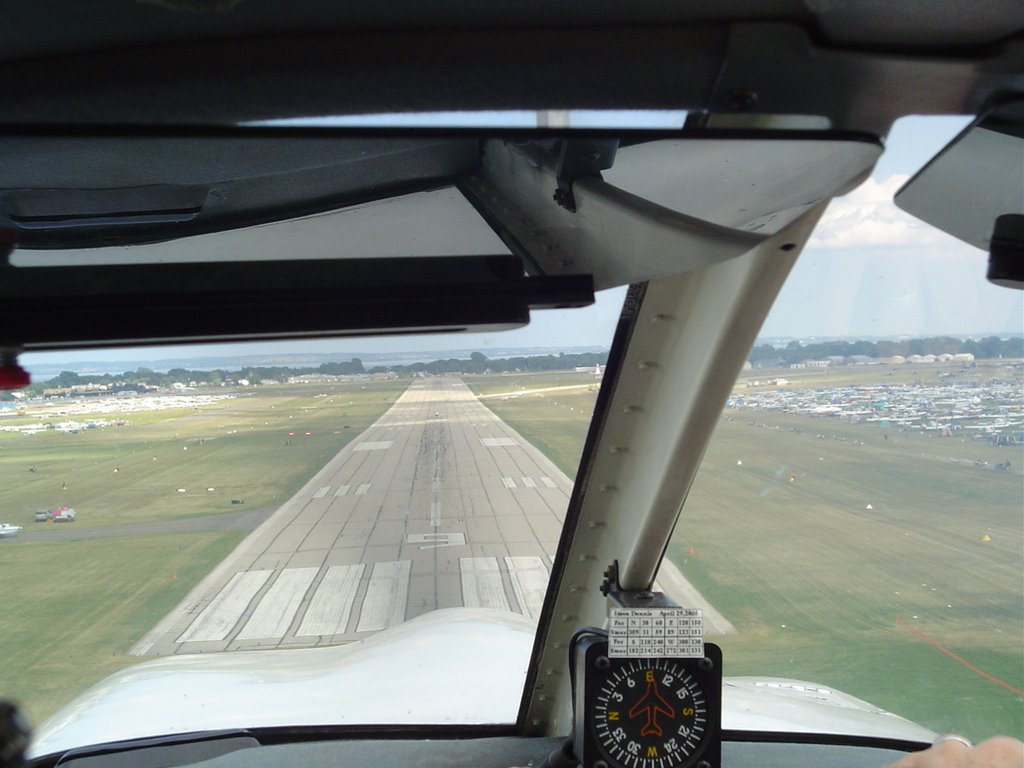
  • 2006 and 2007 Oshkosh trips. There's just something about traveling a long distance via spam can. Along the way, I've stopped in some out of the way places, found some great spots to eat, and met several great folks.
  • Flew into the 2007 Salinas Air Show and hung out right in front of where the Snowbirds parked.
  • Participated in two young Eagles events where I've had the privilege of flying 17 kids, a couple of whom had never flown before.
  • Stayed mostly IFR and night current. At the moment, these are two areas I need to work on :-) I guess that's what happen when a few months go by with little flying activities.
  • Continued to hone my aircraft ownership skills via performing oil changes and whatever else I'm legally allowed to do on an airplane. I doubt I'll ever become an A&P but it sure is fun learning more about what I fly.
Looking ahead a bit, I'm hoping to celebrate a couple more milestones in the near future. I hope to start working on my commercial pilot certificate perhaps early next year. I also plan to complete the next phase of the FAA's WINGS program in lieu of a BFR. I figure it's money well spent getting some recurrent training.

So, yeah, it's fun looking back a bit and remembering things along the aviation journey. If you haven't done so lately, crack that logbook open and remember where you've been and what you've accomplished.

Saturday, October 06, 2007

Seven more Young Eagles

Today was our second annual "airport day" at my home field and I had the privilege of flying seven kids as part of the EAA Young Eagles program (www.youngeagles.org).

It's amazing the different reactions kids have when flying. Some are very excited and ask tons of questions while others hardly say a word (until they are back on the ground and talking to their parents about how fun it was). Today I had kids on both ends of the spectrum. Sometimes I had to ask for it to be quiet so I could hear on the radio and at other times, I was the only one talking as I pointed out landmarks.

Another 1.6 hours in the logbook but a very special 1.6 hours as I had a chance to share my love of flying with seven kids ranging in age from 8-12. Three of these kids had never been in an airplane before and I was lucky enough to be their first pilot. Now, *that* is very cool. I'm not sure who has more fun, the kids or me.

If you ever have a chance to participate in something like this, jump at the chance. Even if you have to rent an airplane, I guarantee that it will be some of the most enjoyable flying you'll ever do.

Saturday, August 18, 2007

Field replacing an alternator

While I'd hoped to post some Oshkosh related items during the trip, that...um...never happened :-)

The trip great as usual. We stopped in a few new places this time which meant we found a total of three new airport dogs to pet. No new airport cats to report though.

Everything was going well with the airplane until approximately 50 miles from Oshkosh when I notice a low voltage indication on the engine analyzer. I go through the drill of cycling the alternator but nothing changes...still reading right at 12 volts where it should be 14-14.1. At this point, I'm not too terribly worried since I recently installed a brand new battery and it's a wonderful VFR day. I do, however, shut down COM2, transponder, and the DME. When arriving at Oshkosh, one never knows when you might be required to hold due to arrivals being temporarily closed.

All goes smoothly with the arrival. Well, there was a Cirrus pilot who got a little concerned (unnecessarily so) about the tight arrival spacing. I was #2 in our flight of 6 and tower called the base turn and cleared my friend ahead of me to land. All of a sudden, the gal in the Cirrus, on maybe a 2 mile straight in final (likely an IFR arrival), says to the tower "You can't do that, I'm on final...I'm going to have to do a 360". Tower responds with "Mam, unless you see something I'm not, I don't see any issues here". Never mind that her doing a 360 in either direction would have been a bad idea due to the current arrival flow. I'm listing to this as I wait for tower to call my right base and clear me to land on 27. My brother picks up the Cirrus, we extend somewhat downwind until tower calls our base and everything works out fine. Sure, the spacing was tight...if this had been a normal airport but this is Oshkosh, you're expected to land on the numbers at the same time someone else is touching down maybe 2000 ft. in front of you. Ah, but I digress...

We setup camp in the North 40 and the next day, I start to investigate our alternator problem. It turns out that the ring connector to the main output stud had broken off due to being old and somewhat rusty. After breaking off, it sat there and arced such that the stud was worn approx. a third of the way through. The stud was also very loose. And, to add insult to injury, we found a crack in the alternator housing. End result: we decide to replace the alternator. It may very well have been the original and I know it had been rebuilt at least once in it's lifetime.

Fortunately, I have a friend who lives about an hour away from Oshkosh and who does a ton of his own maintenance. He is also logging time towards becoming an A&P. He shows up with tools in hand and the first thing we do is crimp on a new ring connector. I then spend a couple hours visiting the vendor exhibits and decide on buying a new Plane Power alternator. Yikes, $450. Ah, but it comes out of the partnership maintenance fund so it's "free"...as in "already paid for". Very cool :-)

The next day, we have the alternator installed and I crank up the plane and verify that it puts out 14 volts with everything electrical turned on. Life is good. It gets even better though as I have another friend who is an A&P and he shows up for a party the next night and says "I understand you need a sigh off for an alternator installation". Why, yes...yes I do. We wander over to the plane, he takes a look, and writes up a logbook entry for me. It sure is nice to have friends in aviation.

Just getting started...dropping the lower cowling:


The installation in full swing:

The rest of the show was great and the trip home uneventful with the alternator outputting it's normal 14-14.1 volts the entire way home.

Saturday, July 07, 2007

Oshkosh preparations

When I start pulling the camping gear down from the garage storage, it's officially Oshkosh preparation time. Bright and early this morning, me and my airport dog in training hit the garage and did just that. Out came the step ladder and down came the camping gear. Airport dog in training was more interested in chewing on sticks in the front yard. He has no idea that his world is about to change when I disappear for 11 days.

Today was a banner day in the Oshkosh related mail department. The last of the ordered charts arrived in the mail...one more thing to check off the "to-do" list. All I need now is a North Central AFD and I'm set. Well, that and print out a bunch of NOS approach plates for a bunch of airports. Last year I ordered and hauled way too many bound NOS charts. This year, I plan to print out whatever I think I'd need based on planned gas and overnight stops. Not only do I kill less trees this way, I haul probably 6-7 less pounds on the 3000 nm journey.

Even better in the package receiving department, my Aircraft Spruce order showed up today. The main component of which is a new Concorde RG battery for the Arrow. Our old battery is on its way out and I really don't want to get stuck somewhere on the way to/from the Left Coast to Oshkosh with a dead battery.

It's time for some serious hangar rat duty. Battery replacement, mounting a fire extinguisher, replacing wing tip screws/washers with new stainless steel hardware, troubleshooting the copilot side PTT switch not working, and gluing on the pilot side right rudder pedal rubber pad. Oh yeah, tonight may be a late one at the hangar but that's ok, I'm long overdue in the hangar rat department.

Another item checked off the Oshkosh to-do list was updating the W&B spreadsheet I've perfected over the last couple of years. I still have to plug in a couple of final numbers but, for the moment anyway, we're approximately 100 lbs under gross with full fuel. Life is good :-)

T-minus 13 days until launch. If I can, I'm thinking about adding blog entires along the route.

Sunday, June 03, 2007

Wing skin crack repaired

Ok, so here's what the fix for our lower wing skin crack looks like:


My friendly A&P suspects oil canning of the lower wing skin. Sounds like this can be caused by a couple of things. Walking on the wing walk area for one and putting the plane on jacks for another. This type of repair is somewhat common for Arrows. There was another one in for annual, sitting right next to ours and it had both sides done. Now I have something to look for when crawling around other Arrows. Reminds me of my brother and how he pokes around homebuilts looking for things that other folks (like me) would never notice.

The plane is out of annual and I performed the required test pilot duties this afternoon. The funny thing is that I was planning to have a friend fly his plane back to my home airport so that he could fly me back to the airport where we had the annual done, I could pickup my car, and go home. All was well and good until we hop in his plane for the return flight and it won't start due to a solenoid problem. So, we put his plane in my hangar then flew back back where we had the annual done. Hopefully the stars will align tomorrow such that he can get someone to look at his plane and we can get our respective babies back in their normal nests. Not that another excuse to go flying is a bad thing :-)

Sunday, May 27, 2007

Wing skin crack...ah, it must be annual time!

It's been far too long since posting anything. Add to that the subject of this post and...well...I'm not sure what to say...other than owning an airplane is always an adventure :-)

After a trip to Redding, CA Friday for an eddy current inspection on our prop hub (another subject altogether...but I'll resist the temptation to digress), one partner and I were crawling around under the Arrow cleaning stuff up a bit. I was under the right wing wiping out the wheel well and generally cleaning the goo off of the landing gear. I started working inboard of the gear, wiping off dirt and grime when I came across this:


The crack is in the forward wing skin, just forward of the rivet line attaching the skin to the spar. It is approximately three inches in length. At the moment, I'm getting some initial feedback from various friends and owners associations. Overall, however, the jury is out on a final solution for fixing this. Judgment day will come next week as we drop the plane off for the annual inspection. Fortunately, we deal with a great repair shop so I'm confident that we'll get the strait scoop on how best to proceed. Bah...just when we were hoping for a more reasonable repair bill than last year when two wing ribs had to be replaced as a result of performing a Piper service bulletin (the dreaded SB1161 for any Piper owners out there). We were on the bleeding edge of that one and it was a rather costly repair. Thank goodness for a partnership and cost sharing!

Here's to hoping for better future posts.

Saturday, February 24, 2007

When parts leave the airframe

Reading John's post about the possibility of a window departing the airframe reminded me of a time when, shortly after takeoff, it was rather obvious that we'd left something on the runway.

I'd flown a co-worker to Minden, NV for an...um...offsite breakfast meeting to discuss how we should approach some software development tasks. Ok, that wasn't it at all. We purposely planned to fly out for a quick breakfast and Minden was the perfect location as I hadn't taken the Arrow on any high altitude/mountain flights. A great way to start the work day, BTW.

Fast forward to the takeoff roll leaving Minden. Everything is normal, positive rate of climb, gear up, turn left 20 degrees on departure, starting to think about the 1000 ft. AGL checks when my co-worker says "We lost the oil door back on the runway". Huh? Sitting up a little more in the seat reveals a nice D-shaped hole in the cowl. Yep, no oil door. Suddenly my mind is filled with questions and it's time for some quick piloting decisions. Do I return to look for it? Do I keep going? Wait, what if it hit the tail/stabilator? Crud, a new oil door is a couple hundred bucks...argh...time to go back to the airport, take a look at the plane then try hunting down the oil door.

We return to the airport, shut down, checkout the plane, then start the oil door hunt. Fortunately, there was no damage to the airframe (well, other than the funny D-shaped hole):

A guy working the glider operations stops by in his truck, says "hop in, we'll drive down the runway to look for it", and off we go. 10 minutes later we see it off the right side of the runway, barely scratched. Our new found friend in the truck calls up a mechanic and after force fitting a piece of hinge wire in place and applying the appropriate amount of 200-mph tape, we're good to go. "How much do we owe you?" I ask. "Nothing" is the reply. Amazing.

As we're crossing Lake Tahoe on the return trip, I have visions of the door flying off to a watery demise. I keep a good eye on the door and it doesn't move.

Thinking back, I don't know exactly when the door came off. Likely, it was just about at the point of rotation. I didn't even see it. My co-worker saw a flash of white as we were about to rotate.

So, stuff leaving the airframe is never good. I'm fortunate that it I found my wayward part. I'm more fortunate that the wayward part was something small. I'm most fortunate that there was no damage to the airframe such that keeping the shiny side up and the dirty side down was a challenge.

Tuesday, February 20, 2007

Not quite one-six right

I recently had a chance to fly down to Southern California for the first time. Since the initial destination was Santa Monica (KSMO), I figured my logbook needed an entry to Van Nuys (KVNY). While I would have loved to hear "Arrow , cleared to land one six right", I had to settle for the "...three four left" version followed a minute later by "...switch landing runways, cleared to land three four right".

Note to self...next time, park somewhere on the East side of the field but we wound up at Million Air since we didn't really think ahead as to where we should have parked. Ah, next time...

Now, if I could just find my camera and post the only picture taken the entire trip...#2 behind a G-IV.

Monday, January 01, 2007

A few random flying pictures

A recent visitor thought I needed more photos...so, here you have it, a post with a few random flying pictures.

My ride, a '71 Arrow-200


11,000 MSL, before sunrise, headed to Palm Springs


Departed Lancaster, climbing to 10,000 so I can pickup my IFR clearance back home.


The entire valley, from Bakersfield to Sacramento is fogged in. Nice to know that I could get down through the overcast if I needed to.


Oshkosh towel rack, 2005


Emerald Bay, Lake Tahoe. From a few years ago on a clear winter day. One of my favorites.


Short final, South Lake Tahoe, flying a a rental '67 C-172

Sunday, December 31, 2006

A look back at my 2006 flying stats

Having seen mention of a few folk's 2006 flying stats, I thought I'd drag out the logbook and take a peek to see what I'd find.

Totals for 2006:
124.1 hrs total, all of it PIC in the Arrow. Yeah, more complex time :-)
8.8 hrs. actual IMC
26.3 hrs. simulated IMC
15.0 hrs. night
63.6 hrs cross country
30.8 hrs. dual
67 instrument approaches,

1 instrument rating, maintained VFR day/night currency and instrument currency plus logged my fourth trip to Oshkosh.

All in all, 2006 was a very nice flying year. I'll conveniently ignore the $8K in required repairs after our last annual and a new Hartzell prop hub AD requiring repetitive 100 hr. inspections (at $300 a pop) or a new hub. Ah, in a partnership, at least such costs are shared.

One goal I've had since becoming a co-owner in the Arrow is to fly at least 100 hours per year. There's no magical justification in that number though...it's more or less a nice round number picked at random that, for whatever reason, makes me feel owning a plane is more justified. As if owning could ever really be justified...but that's another subject.

Here's to wishing everyone a great 2007. May 2007 bring you more hours, nice weather, successful check rides, clean annual inspections...whatever makes for a great flying year (maybe a sharp drop in 100ll?).

Friday, December 29, 2006

There's a first time for everything

The old saying "There's a first time for everything" rang true a couple weeks back as I did my first missed approach in actual IMC where I had absolutely no ground references in sight during the entire final approach segment.

I'd flown to Haward, CA (KHWD) on a fairly benign IMC day. The trip down was more IMC than VMC. Some in/out of the clouds but mostly just brief glimpses of the ground, no horizon though. When I pickup the weather at Hayward, they're calling it 1700 overcast and 2 mile visibility in mist. Approx. 25 miles from Hayward we pop out of the clouds and start getting vectored all over the place as they fit our spam can into the arrival flow. We do a bizarre sequence of 180 and 90 degree turns for 20 minutes in and out of clouds before getting vectored to the final approach course and a descent. Back in the goo, it's getting bumpier and the approach turns out to be one of the more challenging ones I've done. It's a localizer approach with a 440 ft MDA and 1 mile vis. I get the approach clearance somewhere around 9-10 miles out and it's bumpy enough that keeping the localizer centered and a 500 fpm descent rate is pretty tough. The missed approach point is .9 DME from the localizer and as I watch the DME count down, we're still in a big white cotton ball. I'm thinking "ok, where did they hide the airport?" I start thinking seriously about executing the missed approach as we hit 1.5 miles and we're at approx. 1200 ft (yes, I know, higher than I should have been). As the DME clicks down to 1.1 with absolutely no hint of ground/airport/etc. (anything but cloud) in sight, it's time to go missed. Everything on the throttle quadrant goes full forward, positive rate of climb, gear up, flaps up, inform tower that we're going missed, and we get a left turn heading two four zero, and a climb to 2000 ft. At this point, I'm thinking all I want to do is get into VMC conditions and sort things out. I get handed back to Norcal approach and hear the expected "Say intentions" after I check in with them. I ask for a minute to sort things out and they comply with a vector out over the SF bay (not that I could have seen anything that resembled water below us). By this time, I'm ready to go land somewhere, decompress, eat, and reschedule my Hayward appointment so I request vectors to our alternate, Livermore.

As we're headed to Livermore, the controller informs another pilot trying to get to Hayward that the conditions are now 200 ft. overcast. Gee, no wonder we couldn't see anything...the weather had gone in the toilet in the 30-40 minute time frame from the ATIS observation to when we were on the approach. Not uncommon this time of year in that part of the bay. Still, a good reminder of how quickly things can (and do) change.

By the end of the day, I managed two instrument approaches in actual conditions, added another 1.6 to the actual IMC column of the logbook, received my first speed restriction on an approach (don not exceed 110 kts on the Livermore approach), and flown my first missed approach because I couldn't see the airport (and wasn't under the hood :-) ).

Wednesday, November 29, 2006

Nice words from ATC when filing /g

So here I am cruising back North from Lancaster, CA at 10,000 ft above a low overcast that went as far South as Bakersfield and as far North as Sacramento. Life is already pretty good since I was wheels up before 7:00, I was cruising in the sunshine at a cool 4c and my IFR clearance was pretty much as expected.

I get handed off to Fresno approach and after I check in with them, the controller asks "Is this Mark?". Mark is one of my airplane partners and knows just about every controller up and down the Sacramento valley. "Nope, Mark is home wishing he was flying today" is my reply. Five minutes later, I hear "Arrow xyz, you can put that GPS to good use, cleared direct ". A quick glance at the GPS tells me I'm 181 nm from home. The amended clearance likely didn't save me more than five minutes from my original routing but it was very cool to realize the advantage of being able to file /g

As a side note/PIREP, should you need to stop in Lancaster, KWJF is a nice airport and the folks at the Oxford suites will come and pick you up. I had to stay the night due to some pretty strong winds over the mountains. I really didn't feel like surfing the mountain waves in a P28R only to deal with single pilot night IMC in the Sacramento valley so I spent an unplanned night in Lancaster. As the saying goes, "got time to spare, go by air".

Tuesday, October 24, 2006

Correction re: $95 GS

I stand corrected. Our little adventure at the avionics shop where we found our second glide slope simply disconnected due to recessed connector pins cost us $190 to fix, not $95. So, while I was off by a factor of 2 on the price, still, less than .2 AMUs doesn't seem all that bad.

Definition: AMU=Aviation Monetary Unit=$1000

A partner and I flight checked the plane with a combined 5 ILS approaches. Second GS worked like a charm. I definitely prefer using the #1 nav head when flying an ILS though. It's a Garmin, has a bigger donut, GS needle isn't hinged on one side, plus it just feels more normal to look at the #1 nav when flying an ILS. When #1 is driven by the GPS, even with the GS flag up, it seems way too easy to get confused and think you're on the glide slope. That's where the handy dandy round suction cup style soap holders...er, I mean, instrument covers come in handy. Should #1 nav go belly up, out come a custom instrument cover.

Wednesday, October 18, 2006

A little redundancy for a mere $95...priceless!

It's funny how anything less than $100 seems cheap when it comes to fixing something on an airplane (especially when it's your own airplane). Hmmm, must be because after the inevitable $1000+ repairs, anything less than $100 seems like chump change. Go figure.

When we bought the Arrow, one thought I had when looking at pictures of the panel was "Cool, dual glideslopes!"...only to later discover that the glideslope in the #2 nav head didn't work. I don't recall if we were told or if we surmised that we may not have a glideslope receiver for the #2 nav. After just now poking around a bit on the web, I've learned that our nav radios have built in glideslope receivers.

We had the plane at the avionics shop to get the VORs tuned since it's never good when the #1 VOR indicates six degrees left of course when the #2 VOR indicates (correctly) that you're on course. It turns out this was an easy fix for the avionics guys. While doing the work, they informed us that we do indeed have a glideslope receiver on the #2 nav and that our problem can likely be fixed for an hour of labor ($95). We authorize the hour for diagnosis and the problem turned out to be a few recessed pins in a connector. The end result? We now have a functional #2 glideslope and it only cost us $95...ah, life is good. Compared to a rough estimate of $1700 to buy/install a second glideslope receiver, the $95 option is...well...chump change.

Of course, now we *need* to go test fly the plane. Like I said, life is good! :-)

Monday, October 16, 2006

First Young Eagle flights and some unplanned maintenance

Just over a week ago, our airport had it's first annual open house type event. I'd been looking forward to it for about a month when a fuel leak seemed like it might keep me from flying kids as part of the EAA Young Eagles program (http://www.youngeagles.org/).

The day before the event, I'd taken the plane in for a couple minor maintenance items only to fly home, jump out of the plane, and find fuel dripping from the gas coalator. I'm thinking, rats, if I can't get this fixed, I can't fly in the morning. I make a few phone calls, one of which is to my mechanic and get some troubleshooting advice. The next morning, I'm able to get dirty removing the lower cowling so that I can tighten the nut that holds the gas coalator together then re-safety wire it. Shazam, problem solved. A quick test flight once around the pattern, land, check for leaks and it's time to fly some Young Eagles. Good thing I brought a clean T-shirt, I needed it.

When I pulled up to where they were staging the Young Eagles flights from, I can't believe the line of kids waiting. I fill out a form since I'm a first time Young Eagles pilot and within minutes, I have my first three kids and face my first major challenge, shortening up the two rear seatbelts. The rear seat passengers are the smallest folks to have graced the rear seats. It's a good thing since the Arrow doesn't have a ton of rear seat leg room, especially given that I fly with the seat pretty far back. After about 5 minutes of futzing with the belt adjustment, the two guys in the rear seat are ready, I climb in and the kid in the right seat climbs in. We do a short passenger brief, I get a few questions and it's time to go.

Normally, the airport is non-towered but today, they're operating a tower frequency as well as a ground frequency. It's a good and necessary thing as they're conducting some warbird flybys, Young Eagle flights with probably 10 planes participating, and many other flights in/out of the airport. I am happy to report that not once did I begin a radio transmission with "Anycity traffic, ...".

The first flight went fine, even with the little guy sitting behind ignoring the fact that I really meant what I said about needing it quiet at certain times. If it hadn't been for the pilot isolate feature of my intercom, I'd have pulled his mic. jack as he was quite content to make all sorts of noises over the intercom. Oh well, he was having fun...

I land and wind up repeating this process three more times before the event comes to a close. In one day, I go from 0 to 12 Young Eagles. Reflecting on the experience, it was awesome. Hearing things like "This is so cool" from a 15 yr. old on her first small airplane flight, "Everybody looks like little ants" from one of my younger passengers, "This is awesome" several times from other kids was great. Answering questions about becoming a pilot, owning an airplane, where I fly, etc. was also a lot of fun.

By the end of the day, I was pretty much wiped out. So much, in fact, that the plane didn't get the normal post-flight bug wipedown. That turned out to be the perfect excuse to come out to the airport the following day and introduce the new dog to the hangar. Not a bad trade really. He seemed to enjoy himself.

The unofficial count I heard was that we flew 205 kids that day. Not bad considering the original target was 100 kids. I feel privileged that I could use the gifts and talents God has given me to bless 12 of those kids with a free airplane ride.

If anyone has a chance to participate in a Young Eagles event, I'd strongly encourage you to do so. It is a great opportunity to share our passion for flying with kids that will, hopefully, get inspired to learn how to fly. Whatever it costs in terms of airplane and fuel expenses is worth the smiles you'll get in return.

Tuesday, September 26, 2006

Future airport dog


My wife and I just adopted a 7 month old Pointer mix puppy. Little does he know that he's about to become, among other things, an airport dog. Not as a full time canine job though. More along the lines of being there on days when the 6 ft. hangar rat (me) feels the need to tinker with the plane and/or improve/clean/whatever around the hangar. On such occasions, our new pooch will get to come along so he can learn the finer points of hanging out at the airport. I have a feeling that so long as I bring a tennis ball, some doggie treats, water bowl, and a comfy blanket to lay down on, he'll be perfectly happy.

Every airport needs an airport dog...or cat for that matter. When you shut down near the fuel pumps or tie up in transient parking then walk into the FBO, there should be an airport dog there to greet you with a friendly wag of the tail. It's like icing on the cake after a trip to a distant airport.

Once while stopping for gas in Siskiyou County, CA for gas, I'd filled the plane then while walking into the FBO building, noticed that somebody had been watching me. I don't recall the breed but the pooch looked at me, wagged his tail, and figured I must be ok. Either that or the fact that I bought some 100ll kept him from attacking :-) His price: a couple minutes of scratching his ears and neck. I walk into the FBO and repeat the same process with the airport cat. You gotta love general aviation.

I walk back outside and the dog is now laying in the shadow created by the fuselage. Obviously, he's guarding the plane for me. A little coaxing and I get him to move so that I can start up and be on my way. Yep, every airport needs an airport dog. I figure our latest addition to the family is my way of carrying on this time honored tradition of general aviation.

Thursday, September 14, 2006

The joys (ok, maybe some sorrows) of aircraft ownership

After reading a few blog entries on ownership, I've been reflecting on my experience as a co-owner. By no means am I an expert on the subject as I've only been at it for a year and a half. As with earning your pilot's license though, there is always more to learn. The cool thing about owning is that you have untold opportunities to learn about your airplane.


Expen$ive? The short answer is...well, yeah, so what was your point again?
I've heard many folks say that there is no way that ownership is cheaper than renting. I'd agree that when factoring in every dollar that leaves your pocket when you buy and maintain your own airplane, it's going to be a long time before you save any money (if you ever do). OTOH, the per-hour operating costs of owning *might* be less than renting. In my case, for the first year of ownership, this is true, even when considering our unscheduled maintenance. Bottom line: factoring everything in, it's going to cost a bunch of money. One can blow a ton of money on cars, boats, big houses, etc. Is spending a large chunk of cash on a plane (or part of a plane) really any different? I don't think it is. Given what I paid for a 1/3 share of the Arrow, it's not all that different than buying a new car, maybe somewhere between a Honda Accord and a small SUV.


We've had a few unexpected $1000+ maintenance items and experienced a rather painful first annual (the required repairs, that is. The *inspection* was less than $1000. Still, when I consider how much I'm flying now vs. when I was renting, it's worth it to me. The expression that goes something like "If you can light a $100 bill on fire and watch it burn up without being concerned, you're ready for ownership" is pretty much true when it comes to aircraft ownership. When something only costs a couple hundred to fix, the airplane owner tends to rejoice (I know we sure do).


For us, one huge advantage is splitting the costs among the three of us. As a result, I firmly believe that co-ownership is the way to go. Unless, however, you have a bunch more disposable income and can afford outright ownership. I figure that a three way partnership in the Arrow is a step or two up the airplane food chain in terms of what I could afford if it was just me. This directly translates into my being able to fly a lot more (to the tune of around 170 hours in the first year of ownership).


Convenience

This is where ownership/co-ownership has a real advantage over renting. When I rented, rarely could I make any last minute scheduling changes or go flying on the spur of the moment. Now, even with two partners, it's almost like owning my own plane. Our schedules don't overlap much so there is little conflict when it comes to scheduling. Sure, there are occasional conflicts but we've managed to work them out with no problems. I hear lots of people saying that convenience is the main benefit of paying more to own vs. rent. I'd agree that convenience is a big benefit but it's not the only one.


Chance to be a hanger rat

A true hidden gem of airplane ownership is the chance to transform from whoever you are and whatever you do at your day (or night) job into a happy hangar rat. Whenever you spend time in that over priced metal structure housing your (also over priced) airplane, life is just so much better.


Every time I open up our hangar, I feel like someone should pinch me to make sure I'm not dreaming. There's just something about seeing *your* airplane sitting there waiting for you, welcoming you to go fly (or, change the oil, wash/wax, whatever). On those occasions where I don't fly, I have a ball being a hangar rat. I could spend untold hours futzing with the plane or improving the hangar. Oh, wait, I already have spend untold hours doing these things. Can I log that?


Add in the fact that other hangar rats tend to be in close proximity and it just doesn't get much better.


Just last weekend, I spent the morning moving/rewiring the switch for our overhead lights. A simple job that required maybe $15 for wire and tie wraps. Open hangar, turn on stereo, park truck in front of hangar (leaving aviation radio on local CTAF), pull the plane forward a couple feet (so I can walk behind the wing), pull out the tools and life is good.


New terminology, the AMU

I have to give credit to John K. on the rec.aviation newsgroups for this one. It came from somewhere else but I first heard it from him. In aircraft ownership, when talking dollars, there is an important conversion factor. 1 AMU (Aviation Monitary Unit) = $1000. So, when it came to our pitot/static cert., rebuilding our altimeter, and replacing an AP roll cable, saying "The repairs cost 1.3 AMUs" sure sounds better. It worked for the repairs that were performed after our last annual. It was still single digit in terms of AMUs. Proof positive that ownership is expen$ive.


All things considered, I'm glad I'm in the position to co-own and I feel very fortunate to be doing so.

Monday, September 11, 2006

Most interesting ATC radio communication I've heard

"Arrow xyz, turn left heading two seven zero, vectors for active air show"

Last Sunday, my wife and I were cruising home from the San Francisco Bay area at 4500 MSL descending to 3500 MSL, just East of Concord, CA (KCCR). I'd been trying to get in touch with the local TRACON for flight following but the bay area frequencies were pretty jammed so I opted to wait until just prior to entering Travis Air Force Base's airspace and contacting Travis Approach. I call them up, they have me change frequencies, ident, they give me the local altimeter setting then tell me to stand by for a squawk code.


Everything is normal, right? Um…no, not exactly. The next thing I hear is "Arrow xxx, turn left heading two seven zero, vectors around active air show". Now, *that* got my attention. I hang a 110 degree turn to the left and start wondering where I went wrong in my pre-flight weather & NOTAM briefing. There were no graphical TFRs along my route and I'm wondering if I missed a NOTAM for an air show at Stockton, Lodi, Tracy, Rio Vista…Travis AFB maybe.


A minute later, I get vectored heading 360 degrees and this will pretty much put is over the center of Travis's air field. I'm thinking that Obviously, the air show activity isn't at Travis. Five minutes or so later, I'm told I can resume my own navigation so I turn back to my original heading before this little zigzag and fly maybe three miles away from Travis's runways but now at 3500 MSL.


Before I exit Travis's air space, I hear two other spam cans get vectored around the air show activity. Funny, nobody asked "Travis approach, where is the air show?". I sure wanted to but didn't want that on record with the ATC recordings.


When I got home, I searched through the NOTAMs and googled everything I could think of for local air shows. Zip…nada…nothing. So, I'm left wondering if Travis was doing something in a corner of their air space and just wanted everyone to stay the heck away.


Ah, well, I didn't bust any TFRs and it was a pleasant flight. I'm still scratching my head wondering what was going on though. If any Bay Area folks know what was going on, please drop me a line.

Friday, August 18, 2006

Oshkosh 2006...long...very long


A long-ish trip report on our adventure this year...

This marks the fourth year I've made the trek from the left coast to
Wisconsin for the big show. This year, it's me, my wife, my brother,
and his wife stuffed into our '71 Arrow. With four of us and 36 gallons
of gas, we can haul a grand total of 165 pounds of gear. Not a shred of
camping gear made the trek this year. Fortunately, I have a friend who
lives in the Twin Cities area and he delivered the camping goods.

Left coast to Oshkosh:

Day 1: Lincoln, CA to Elko, NV for first gas stop. We wanted to make
it to Wendover, UT but with a long climb to get over the Sierras and a
slight headwind (yes, despite the fact we were going East), KEKO was the
first gas stop. We were planning three hour legs with our limited fuel
carrying ability.

Elko to Ogden, UT for gas stop #2 and lunch at the Auger Inn restaurant.
Note to self: Next time, hit the self serve fuel pump on the North
side of the tower next time. The FBO topped off the tanks after being
told to fill to the tabs. End result: we stay in Ogden for the night as
it took them forever to defuel 14 gallons of 100ll. It was for the
better since the ride across the mountains to the East of the Salt Lake
area would have been quite bumpy. So...if anyone stops in Ogden for
gas, I can't recommend the FBO that resides on the South side of the
tower. Can't remember their name (nor want to).

Day 2: First leg is Ogden to Rawlins, WY. Wheels up just after sunrise
and the air was very smooth. Quick stop at Rawlins for gas and we're
off to Alliance, NE for gas and lunch. Last leg is to Iowa City for Jay
and Mary Honeck's pre-OSH bash at the Alexis Park Inn and Suites. Park
Inn & Suites. First Bratwurst of the trip...yum.

Day 3: Iowa City to Oshkosh as a flight of three with the Honeck's and
Edwin Johnson in his Maul. We manage to keep sight of each other all
the way.

I need to stop here a second and explain a bit about the Oshkosh arrival
procedure. It's spelled out very clearly in a NOTAM. When you're
approx. 50 miles away, you tune in the arrival ATIS and listen for the
weather conditions and which runways are in use. You then aim for the
town of Ripon (there is even a GPS waypoint for it now) and arrive at
1800 MSL and 90 kts (for our class of airplane). You look for other
aircraft and essentially get in line with 1/2 mile spacing between you
and the guy in front. You fly right over a set of railroad tracks at
1800 MSL and 90 kts. You listen to the Fisk approach controllers as
they identify aircraft by type/color and you don't speak on the radio
unless asked a question by the controllers. As they identify you, they
ask you to rock your wings so they know you hear them. Then, they
instruct you to proceed a specific direction for a specific runway (each
of which is spelled out in the NOTAM). You then switch frequencies to
one of two tower controllers (runway 9/27 or 18/36), depending on what
the Fisk approach controller had you do. If things get a little bunched
up, there are two possible locations to hold. There are two lakes.
Green Lake is outside of Ripon and Rush Lake is between Ripon and Fisk.
Sounds pretty simple, eh?

When we listen to the arrival ATIS, we learned they were holding over
Green Lake. Ok, no problem. We enter the hold and it's just no fun as
there are planes everywhere...a couple of miles from the shoreline
(you're supposed to be over the shoreline), flying slower than 90 kts,
and talking back to Fisk approach (and other pilots) on the radio. We
end up doing maybe 6 laps around Green lake before bugging out to Fond
Du Lac for gas/food/pee stop. I call Jay from Fond Du Lac and find out
that he made it through the gauntlet and is parked in row 558. After an
hour and a half or so, we find out that they're not holding so launch
from Fond Du Lac and the arrival goes pretty much ok. Well...until
we're just turning final for runway 9 and a Meridian is about a mile
away at our 3:00. Tower is talking to him and doesn't seem to see us.
I'm set for a go around but the Meridian zips by then tower sees us and
has us put it on the numbers. Welcome to Oshkosh (though I didn't hear
those words this year). We end up in row 575, just abeam the Hilton.

The camping gear soon shows up and we set things up. It's warm and
humid but everything is suddenly right in the world because, well, we're
at Oshkosh and we just setup camp next to our plane.

Stuff we did, in no particular order:

  • Saw a pair of F-22 Raptors. Very cool demonstration!
  • Watched the B-1 arrive. Also very cool.
  • Walked around a British Lancaster. It's amazing how different that plane sounds when flying...almost like a flight of P-51s. Hmmm, must be those RR Merlin engines.
  • Watched the ultralights come and go one morning in their little chunk of airspace.
  • Sat one table away from Chuck Yeager while eating breakfast at the Hilton one morning. Later on, my wife made a comment to another guy at a nearby table...turned out it was Harrison Ford. Only at Oshkosh...
  • listened to Bob Hoover give a talk about his flying days.
  • Toured the museum (again)
  • Hit the seaplane base (again)
  • Got wet (again...rained like crazy one night and my bag was up against the side of the tent. oops).
  • Generally walked ourselves silly in way too much heat/humidity. It was a ton of fun though.
The trip home was fairly uneventful. We made two nights out of it. The first night was Ainsworth, NE and the second night was Winnemucca, NV. I had the most wicked cross wind landing of my life at Winnemucca. Very gusty and shifting winds and I had to work pretty hard on that landing.

Ok, this was a really long post. Believe it or not, I could keep going...but I won't. I should have posted this a long time ago. Been meaning to, just never got it finished...until now.

33.4 hours flying time for the trip.